
Sage X3 Modules & Capabilities
Sage X3 is rated across 13 of 14 ERP modules, 6 of them a core strength and 1,746 documented capabilities catalogued across those modules.
- 13of 14
- Modules rated
- 6
- Core strengths
- 1,746
- Documented capabilities
- Cloud / On-Premise
- Deployment
Sage X3 module ratings
Ordered strongest to weakest. Each rating reflects standard-edition depth, not what a third-party add-on could bolt on.
Finance & Accounting
strongCore financial management including general ledger, accounts payable/receivable, fixed assets, cash management, and financial reporting. The backbone of any ERP system.
›600 documented capabilities in 58 areas
Finance & Accounting
strong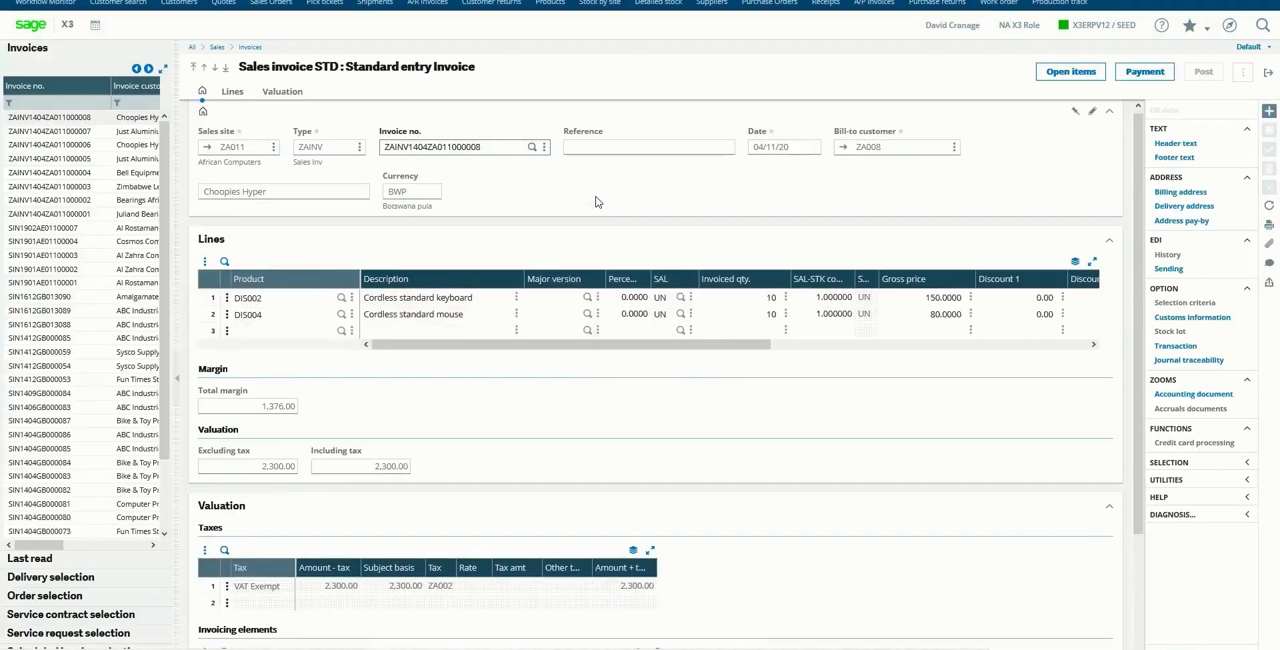
Cost calculations6
Calculates standard, revised, budgeted, and simulated product costs from routing and BOM data, and updates deferred cost calculations.
Standard Cost Calculation · Revised Cost Calculation · Budgeted cost calculation · Simulated Cost Calculation · Calculated cost update
Journals5
Handles the entry and management of accounting journals, including batches, commitments, and transactions between related companies.
Journal entry · Batch Entry · Commitments · Intercompany journal entry
Invoicing12
Groups the tools for entering, posting, and automating customer and supplier invoices, including intercompany, recurring, and prepayment invoice types.
Customer BP Invoices · Customer intercompany invoices · Recurring customer invoices · Supplier invoices · Invoices Pending
E-invoicing13
Covers electronic invoice setup, sending, and receiving, including XML mapping and inbound invoice collection.
Setup · XSD file upload · XML mapping rules · Sending · Customer e-invoice preparation
Budget management8
Covers defining entities, projects, budget envelopes, and budget lines, plus inquiring on budget positions and cancelling or closing budgets.
Entities · Projects · Budget envelopes · Budget lines · Budget positions
Fixed assets6
Covers the core fixed asset records, including expenses, assets, depreciation plans, renewal provisions, and production plans used to build and depreciate company assets.
Expenses · Asset · Depreciation plan · Provisions for renewal · Production Plan
Production costs7
Calculates and reviews the actual cost of work orders, comparing planned versus actual figures and finalizing WIP valuation.
Production Cost Calculation · Production Cost Inquiry · WIP Cost Inquiry · WIP finalization · Provisional Cost Inquiry
Inquiries10
Provides read-only views into general ledger balances, accounts, dimensions, entries, and bad debts.
Converted balance · Analytical balances · Balance in currency · Accounts · Natures
Open items12
Covers open item tracking and editing, statement creation, customer credit holds, prepayment allocations, cash forecasting, reminder campaigns, net settlement, and interest note generation.
Open items · Open Item Edit · Statement Creation · Customer hold · Customer allocations
Sage Network15
Covers synchronizing data and document status with Sage Network, plus AP automation for processing incoming supplier documents.
Synchronization · Data sync · Monitoring · Get synchronization tasks · Query synchronization tasks
Approval management6
Covers submitting, approving, rejecting, listing, and cancelling approval requests for budget envelopes, budgets, and budget lines.
Submit for approval · Approval / Rejection · Approval list · Approval inquiry · Approval cancellation
Processes26
Groups the operational processing applied to fixed assets after creation, covering context status checks, depreciation runs, physical and accounting movements, and VAT adjustments.
Status of contexts · Depreciations · Revaluation · Depreciation calculations · Depreciation simulation
Payments13
Covers the payment cycle from proposals and manual entry through notes payable/receivable posting, bank allocation and deposit, positive pay files, due date extensions, and doubtful receipt tracking.
Payment Proposals · Payment/Receipt Entry · Notes payable/receivable posting · Bank Allocation · Bank Posting
Subcontract costs5
Calculates and reviews expected, provisional, and actual costs for subcontracted production orders.
Calculate Sb-cont Expected Cost · Provisional Cost Inquiry · Calculate actual sbcont cost · Production Cost Inquiry
Matching4
Pairs related accounting entries, such as an invoice and its payment, to simplify balance analysis, whether matched manually, automatically, or reversed.
Manual Matching · Automatic Matching · Unmatching
Tax management72
Covers VAT and sales tax setup, calculation, and declaration tools, both a general process set and country-specific requirements for Austria, Belgium, Germany, Italy, Portugal, Spain, the United States, Australia, the United Arab Emirates, Saudi Arabia, Bahrain, Switzerland, the United Kingdom, France, and South Africa.
Others · Setup · VAT boxes · VAT form · VAT entities
Review management4
Covers requesting, approving or rejecting, and listing reviews of budgeted amounts for approved envelopes, budgets, and budget lines.
Review requests · Review approval/rejection · List of revisions
Physical management4
Covers the physical elements attached to fixed assets, including location transfers and mass issue processing.
Physical elements · Mass geographic transfer · Mass issue
Common tables18
Groups shared reference tables — countries, currencies, languages, units of measure, postal codes, and tax setup — that underpin data entry across the system.
Country · Geographic subdivisions · Currencies · Currency Rates · Languages
Performance analysis5
Compares projected and historical costs across products and sites to track cost performance over time.
Cost Comparisons · Multiple Cost Comparison · Cost History · Production Cost History
Current processes17
Runs the day-to-day accounting processes that finalize, post, simulate, reverse, and generate journal entries across ledgers.
Finalize journal entries · Batch Posting · Balance Transfer Validation · Intercompany journal creation · Simulations
Remittances5
Groups automatic and manual bank remittance creation, intermediate posting, and electronic remittance file generation for payment transactions requiring a deposit step.
Automatic remittance creation · Manual remittance creation · Intermediate Posting · Electronic remittances
Fee declaration25
Covers fee and withholding declarations, with general TDS file parameters plus country-specific processes for France, Belgium, and the United States.
Others · TDS File Parameters · France · Setup · DADS-U file
Budget closing4
Covers renewing annual envelopes and carrying forward commitments and multi-annual envelope balances into the next fiscal year.
Renewal annual envelopes · Carry-forward of commitments · Carry-forw. plurian. env.
Funding7
Covers how fixed assets are financed, including lease contracts and subsidies.
Lease contracts · Lease contract · Generation of fee events · Subsidies · Subsidy
WIP3
Values production work-in-progress and posts it to the accounting ledger.
WIP Valuation · WIP Accounting Interface
Closing processes11
Runs the month-end and year-end close, generating accrual entries, currency variances, revenue recognition, and fiscal year-end postings.
Invoices receivable · Credit memos receivable · Invoices to be issued · Closing accruals · Conversion Variance
Payment orders7
Covers paying bank notice generation and entry, bill of exchange import, and manual or automatic reconciliation of notes payable/receivable with the issuing bank.
Paying Bank Generation · Paying Bank Entry · Bill of exchange import · Manual reconciliation · Automatic reconciliation
Intrastat14
Covers Intrastat statistical setup and file generation, with country-specific processing for Spain and Portugal.
Others · Setup · Statistical rule · Transaction nature · Movement rules and natures
Concession10
Covers concession contracts and the assets held under them, including renewal processing.
Contract · Concession contracts · Revisions · Concession end · Assets in concession
Budgets7
Creates, adjusts, copies, and reports on financial budgets across accounts and analytical dimensions.
Budget entry · Budget adjustments · Budget Copy · Budget Formula Codes · ENG-Update of BI budgets
Bank transactions21
Covers bank statement entry, import, deletion, and reconciliation, plus single-entry matching, country-specific extensions for Belgium and Switzerland, a cashbook, and advanced bank statement processing.
Reconciliation · Bank Statement Deletion · Bank Statement Entry · Bank Statement Reconciliation · Reconciliation Reversal
Other declarations8
Covers the payment balance declaration, a regulatory filing that tracks payment balances.
Payment balance declaration · Setup · Payment balance field settings · Product/reason code · Payment balance configuration
Intra-group sales6
Manages the transfer or sale of fixed assets between companies in the same group, from operation setup through issue confirmation.
Operation definition · Pre-recording of issues · Manual adjustments of issues · Transfer confirmation · Setup of asset selection
Invoices10
Covers customer invoicing across every trigger: direct-invoice orders, service contracts, service requests, invoicing schedules, shipments, and intercompany transfers, along with validation and prepayment issuance.
GESSIH · Automatic Order Invoicing · Automatic contract invoice generation · Automatic Service Invoice Generation · Scheduled invoice generation
Reporting7
Extracts financial data for reporting, consolidation, and cash flow analysis.
Financial data extraction · Inquiry · Calculation · Extract for conso · Offset extraction
Inquiries10
Provides read-only views into customer and supplier balances, aged balances, payments, invoices, bank activity, banking position, and interest notes for tracking and risk assessment.
Customer situation · Supplier situation · Customer aged bal to date · Supplier aged bal to date · Payments
Audit19
Covers statutory audit file exports and interfaces for France, Germany, Portugal, and the United Arab Emirates.
France · Setup · ACCENTFIL setup · Processes · ACCENTFIL interface launch
Inquiries3
Provides inquiry views for depreciation simulation results and journal traceability of fixed asset documents.
Depreciation simulation · Journal traceability
Interfaces18
Exchanges data with other Sage products and third-party tools, covering treasury, cash management, consolidation, tax, and payroll integrations.
Export open items to Sage treasury · Export payments to Sage Cash Management · Import transfers from Sage Cash Management · Consolidation export to Sage · Balance Export
Factoring7
Covers assigning receivables to a factoring company and managing the resulting receipts, including generation, cancellation, posting, file export, and payment notification.
Factor Assignment · Receipt Generation · Receipt Cancellation · Receipt Posting · File generation
Printing3
Covers print formats for tax management and fees declaration reports.
Tax management · Fees declaration
Utilities10
Provides maintenance utilities for fixed assets, covering recalculation, synchronization, mass recoding, data recovery, and depreciation plan cleanup.
Pending modifications · Context synchronization · Mass recoding · Abel Enterprise recovery · Current DEPREC creation
General accounting tables21
Groups the reference tables for general and analytical accounting setup, including account structures, dimensions, fiscal years, and period management.
General · Accounts · Account Pyramids · Account groups · Journal Codes
Invoices3
Handles supplier invoice and credit memo entry, reconciliation against orders and receipts, and the validation that posts them to accounting.
Invoices · Invoice Validation
Utilities29
Provides administrative tools for resynchronizing balances, closing periods and fiscal years, and adding new ledgers.
Resynchronizations · Document · Commitments · Account Balances · Analytical balances
Expense notes3
Covers entering, posting, and paying employee expense notes.
Expense form entry · Expense posting
Inquiries6
Provides reporting and lookup views across the sales cycle, covering quotes, orders, deliveries, invoices, returns, allocations, and picking and parcel detail.
Invoices · List of Invoices · Invoice lines · Invoices by sales representative · Invoice ranking
BP accounting tables9
Groups the reference tables for business-partner-related accounting setup, covering bank accounts, petty cash, currency groups, and economic reason codes for regulatory declarations.
Economic reason codes · Economic reason/BP groups · Bank Accounts · Petty Cash · Bank Allocations
Utilities4
Provides maintenance tools for sales data, including resynchronizing customer credit balances, calculating sales commissions, and initializing tax codes for Sage Sales Tax.
Resynch. Cust. balances Resynchronization of customer balances · Paid commissions · SST initialize open documents
Fixed assets tables9
Groups the reference tables for fixed asset setup, covering account groups, section associations, revaluation indices, buildings, and locations.
Account groups · Associations - values · Definition of accounting funds · Revaluation coeff. and indices · Buildings
Inquiries5
Provides reporting and lookup views across the purchasing cycle, covering requests, subcontract activity, receipts, invoices, orders, returns, and shipments.
Invoices · List of Invoices · Invoice lines · Invoices by period · Invoice ranking
Periodic processing4
Runs periodic stock maintenance: valuation and cost adjustments, purging old data, resolving shortages, validating stock history periods, and calculating ABC classes.
Valuation · Cost adjustment · Accounting interface · Stock valuation report
Utilities4
Provides maintenance tools for purchasing data, including resynchronizing supplier balances, recovering commitments, and checking inter-site contract consistency.
BP Balance resynchronization · Commitments recovery · Inter-site contract control
Products6
Covers core product master data, including categories, site- and warehouse-specific settings, versioning, and standard cost records.
Products-costs · GESICD · Revised standard costs · Budget standard costs · Simulated standard costs
Utilities4
Provides maintenance tools for stock data, including valuation adjustments, put-away and reorder recovery, location and serial number resynchronization, and transaction consistency checks.
Valuation · Value change · Stock valuation period resync · Posting date modification
Costing4
Covers manufacturing cost setup, including costing dimensions and the overhead categories and codes used in cost calculations.
Costing Dimension · Overhead Categories · Overhead Codes
Other capabilities6
Cost Transfer
Manufacturing
strongProduction planning, shop floor control, BOM management, MRP, and manufacturing execution. Supports discrete, process, and mixed-mode manufacturing environments.
›227 documented capabilities in 25 areas
Manufacturing
strong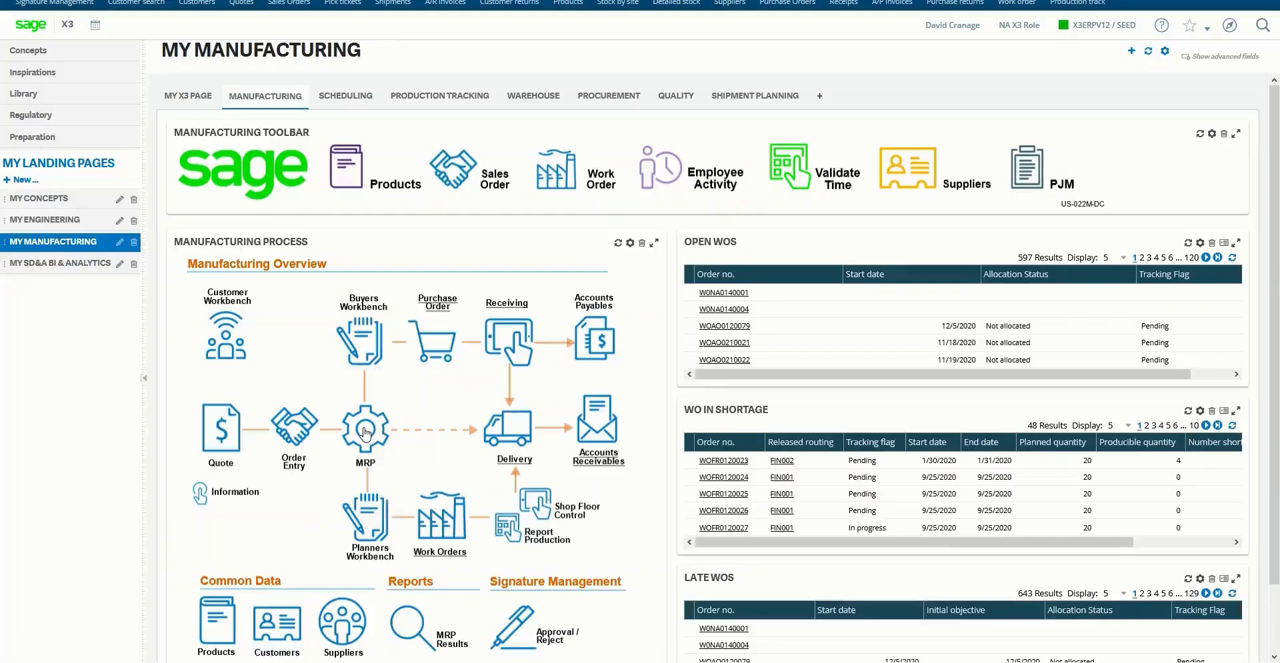
Technical data23
Defines the master data behind production, including product designs, work centers, and routings used to build and process bills of material.
Product design · Work centers · Work center groups · Work centers · Where-used Work centers
Cost calculations6
Calculates standard, revised, budgeted, and simulated product costs from routing and BOM data, and updates deferred cost calculations.
Standard Cost Calculation · Revised Cost Calculation · Budgeted cost calculation · Simulated Cost Calculation · Calculated cost update
Planning11
Covers demand forecasting, master and material requirements planning, and the workbenches used to turn projected and actual demand into work orders.
Demand forecasts · Enterprise planning · Planning workbench · Grouping · Work order
Production costs7
Calculates and reviews the actual cost of work orders, comparing planned versus actual figures and finalizing WIP valuation.
Production Cost Calculation · Production Cost Inquiry · WIP Cost Inquiry · WIP finalization · Provisional Cost Inquiry
Batch processes18
Runs mass, automated updates across work orders, such as allocating materials, scheduling, releasing, shifting dates, and cleaning up records, instead of handling each one individually.
Allocation/deallocation · Allocation · Automatic deallocation · Scheduling/descheduling · Scheduling
Subcontract costs5
Calculates and reviews expected, provisional, and actual costs for subcontracted production orders.
Calculate Sb-cont Expected Cost · Provisional Cost Inquiry · Calculate actual sbcont cost · Production Cost Inquiry
Common tables13
Groups shared reference tables — countries, currencies, languages, units of measure, postal codes, and tax setup — that underpin data entry across the system.
Country · Geographic subdivisions · Currencies · Currency Rates · Languages
Production tracking management15
Records progress against work orders as it happens, including material issues, operation activity, time, and finished-goods receipts, plus tools to close and manage tracking plans.
Production tracking · Work order status · FUNMCLOSE · Mass closing/completions · Time tracking plan
Performance analysis5
Compares projected and historical costs across products and sites to track cost performance over time.
Cost Comparisons · Multiple Cost Comparison · Cost History · Production Cost History
Product tables10
Groups the reference tables for product setup, covering product lines, reorder policies, stock statuses, warehouses, locations, packaging, and quality records.
Product Lines · Reorder policies · Stock Statuses · Warehouses · Location Types
Subcontract5
Manages subcontract purchase orders end to end, including allocating and deallocating the materials suppliers need and closing out completed subcontract work in bulk.
Subcontract Orders · Automatic Allocations · Mass closure/completions · Automatic deallocations
Weighing7
Manages the weigh-station process for verifying and reconciling component quantities issued to firm work orders.
Weighing plan · Weighing · Reconciliation · Weighing Situation · Cancel weighing
WIP3
Values production work-in-progress and posts it to the accounting ledger.
WIP Valuation · WIP Accounting Interface
Manufacturing tables8
Groups the reference tables used in manufacturing setup, covering tracking messages, storage and handling instructions, employee and shift codes, and rejection reasons.
Messages · Storage/handling instruction sheets · BC division rules · Employees · Shift code
Inquiries24
Provides read-only views into production data, including work center loads, allocations, WIP, stock, planning results, and tracked activity, for monitoring shop floor status.
Loads · Loads · Graphical loads · Allocations · Allocations
Analyses4
Evaluates production output and efficiency at one or more sites, feeding resource- and product-level reports.
Production analysis · Resource analysis report · Product axis report
Utilities4
Offers supporting tools for tracing component demand, reactivating closed work orders, and resynchronizing production data.
Pegging history · WO reactivation · Load resynchronization
Production Scheduler7
Visualizes and manages work order scheduling on a Gantt chart, supporting both short-term adjustments and longer-term capacity simulation.
Production Scheduler · Production Scheduler viewer · Remove from scheduling · Production Scheduler custom values · Submit for scheduling
Finite scheduler5
Connects work order scheduling to Sage X3 Web Scheduling or a third-party scheduling solution through a generic finite scheduler interface.
Submit for scheduling · Scheduler custom values · Resubmit for scheduling · Remove from scheduling
Inquiries3
Provides reporting and lookup views across the purchasing cycle, covering requests, subcontract activity, receipts, invoices, orders, returns, and shipments.
Subcontract · Allocation Shortages · Subcontract consumption
Products7
Covers core product master data, including categories, site- and warehouse-specific settings, versioning, and standard cost records.
Product Categories · Products · Products-warehouses · Versions · Products-sites
Inquiries3
Provides lookup and reporting views across stock levels, movements, allocations, locations, quality history, and MRP or MPS reorder results.
MRP/MPS reorder · MRP results · MPS results
BOMs18
Covers bill of materials management, including BOM codes, commercial, production, and subcontracting BOMs, where-used and replacement tools, and multilevel views.
BOM codes · Commercial BOMs · Sub-contracting BOMs · Multilevel BOMs · Where used
Configurator6
Covers the product configurator, which runs configuration scenarios, manages selections, automates scenario testing, and tracks configuration history.
Configurator · Selections · Automate Configurator · Purge Configurations · Configuration history
Other capabilities10
Cost Transfer
Supply Chain
strongEnd-to-end supply chain visibility including demand planning, supply planning, logistics, supplier management, and supply chain analytics.
›40 documented capabilities in 7 areas
Supply Chain
strongSupply4
Provides planning workbenches that give buyers a consolidated view of demand and in-progress procurement events, helping them convert requirements into new orders.
Enterprise planning · Planning workbench · Grouping workbench
Shipment preparation6
Prepares customer shipments by generating pick lists and picking tickets, planning preparation, and recording packaging and parcel details.
Generate preparation lists · Preparation plan · Declared packing · After packing · Picking tickets
Intrastat14
Covers Intrastat statistical setup and file generation, with country-specific processing for Spain and Portugal.
Others · Setup · Statistical rule · Transaction nature · Movement rules and natures
Shipments5
Tracks inbound shipments from suppliers, including container consolidation, transport arrangements, and advance pre-receipt of goods before formal receiving.
Container · Shipments · Transport · Shipment pre-receipt
Inquiries3
Provides reporting and lookup views across the purchasing cycle, covering requests, subcontract activity, receipts, invoices, orders, returns, and shipments.
Shipments · Transport · Shipment lines
Utilities4
Provides maintenance tools for purchasing data, including resynchronizing supplier balances, recovering commitments, and checking inter-site contract consistency.
BP Balance resynchronization · Commitments recovery · Inter-site contract control
Transport note4
Covers transportation note management for tracking non-merchandise shipments, including note types and mass validation.
Transportation note type · Transport note · Transportation note validation
Inventory Management
strongInventory tracking, stock management, reorder point planning, multi-location management, and inventory valuation across warehouses and locations.
›181 documented capabilities in 20 areas
Inventory Management
strong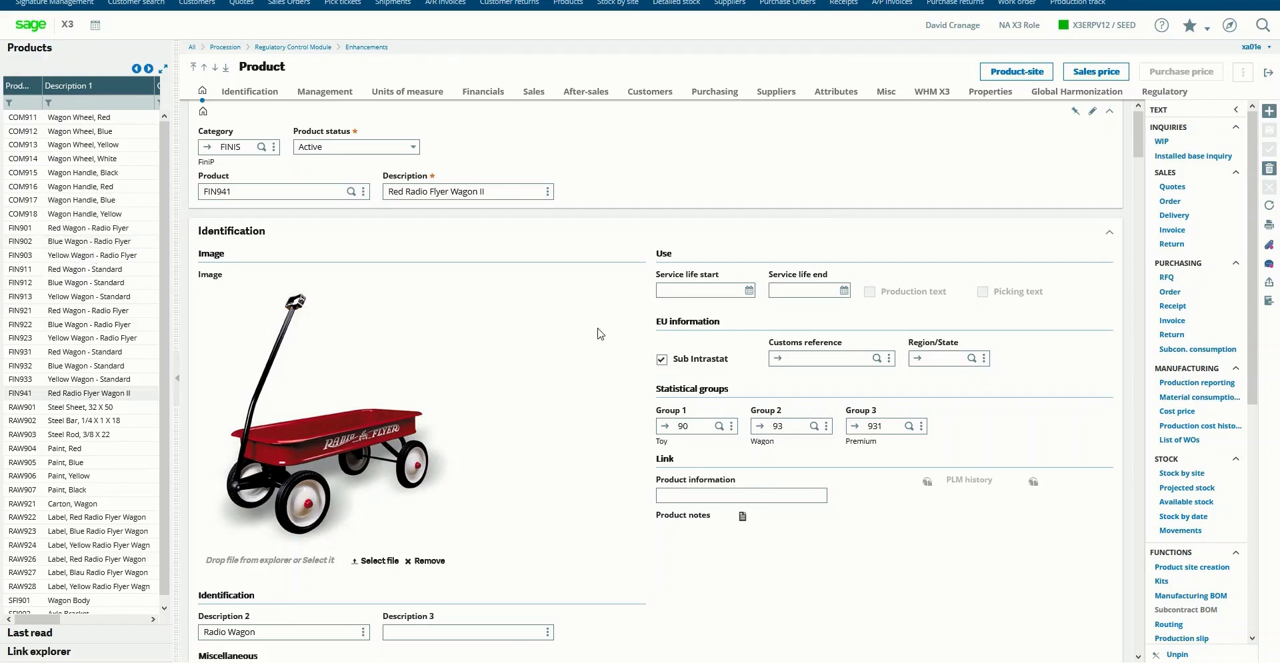
Planning11
Covers demand forecasting, master and material requirements planning, and the workbenches used to turn projected and actual demand into work orders.
Demand forecasts · Enterprise planning · Planning workbench · Grouping · Work order
Packing4
Manages packaging for outbound stock, from declaring package types to assigning parcel numbers and looking up parcel contents.
Declared packing · After packing · Parcel content inquiry
Batch processes3
Runs mass, automated updates across work orders, such as allocating materials, scheduling, releasing, shifting dates, and cleaning up records, instead of handling each one individually.
Allocation/deallocation · Allocation · Automatic deallocation
Allocations5
Reserves stocked products for customer orders, whether through manual reservations, automatic batch allocation, product-level allocation, or reversing an allocation.
Customer Reservations · Automatic Allocations · Automatic Deallocation · Allocations by product
Receipt/issue transactions13
Covers every stock receipt and issue transaction: multi-product receipts and issues, customer deliveries, intersite and subcontract transfers, and purchase order receiving.
GESSMR · Miscellaneous Issues · Deliveries · Deliveries · Order delivery generation
Internal flows7
Manages internal stock movement: replenishing pick locations, reordering and putting away stock, changing stock status or location, and assembling or disassembling products.
Pick location replenishment · Reorder plan · Put-away plan · Stock change · GESBBY
License plate numbers6
Manages license plate numbers used to track containers of stock, covering their creation, assignment, and the operations and stock change transactions performed against them.
License plate number · License plate number operations · Container creation · Stock change transactions · License plate number assignment
Inquiries6
Provides read-only views into production data, including work center loads, allocations, WIP, stock, planning results, and tracked activity, for monitoring shop floor status.
Stock · Available stock · Projected stock · Reorder results · MPS results
Counts6
Manages physical inventory counting, from estimating annual count volumes and identifying what to count to running count sessions and tracking counts in progress.
Physical Count Calculation · Stock To Count · Stock count session · Counts · Stock Being Counted
Shipment preparation5
Prepares warehouse shipments by generating preparation lists and picking tickets, planning the pick, and looking up picking ticket status.
Generate preparation lists · Preparation plan · Picking ticket inquiry · Picking tickets
Reorders4
Plans replenishment through demand forecasting, statistical reorder methods, and full MRP-based material requirements planning.
Demand forecasts · Statistical Reordering · MRP processing
Inquiries3
Provides reporting and lookup views across the sales cycle, covering quotes, orders, deliveries, invoices, returns, allocations, and picking and parcel detail.
Allocations · Allocations · Allocation Shortages
Assignments4
Assigns and removes resources against ranges of product codes for use with in-progress orders, with a workbench to manage assignments.
Assignment workbench · Assignments · Deassignments
Periodic processing16
Runs periodic stock maintenance: valuation and cost adjustments, purging old data, resolving shortages, validating stock history periods, and calculating ABC classes.
Valuation · Cost adjustment · Accounting interface · Stock valuation report · Purge
Products13
Covers core product master data, including categories, site- and warehouse-specific settings, versioning, and standard cost records.
Product Categories · Products · Products-warehouses · Versions · Products-sites
Inquiries43
Provides lookup and reporting views across stock levels, movements, allocations, locations, quality history, and MRP or MPS reorder results.
Stock · Stock by Site Report · Stock by product · Stock by lot · Serial Numbers
Utilities13
Provides maintenance tools for stock data, including valuation adjustments, put-away and reorder recovery, location and serial number resynchronization, and transaction consistency checks.
Valuation · Value change · Stock valuation period resync · Posting date modification · Recovery of put-away plan
Quality control9
Manages product quality control, from requesting analyses and inspecting stock before put-away to changing lot status for re-checks, obsolescence, or corrections.
Analysis request · Quality control · Re-control Status Change · Obsolete lot status change · Lot modifications
Costing4
Covers manufacturing cost setup, including costing dimensions and the overhead categories and codes used in cost calculations.
Costing Dimension · Overhead Categories · Overhead Codes
Other capabilities6
Cost Transfer · Container label printing
Procurement
strongPurchase order management, supplier management, requisition workflows, contract management, and spend analytics.
›113 documented capabilities in 15 areas
Procurement
strongPrice lists3
Manages the price lists suppliers apply to purchased products, letting buyers look up applicable prices and enter new price list records by code.
Price search · Price Entry
Supply4
Provides planning workbenches that give buyers a consolidated view of demand and in-progress procurement events, helping them convert requirements into new orders.
Enterprise planning · Planning workbench · Grouping workbench
Approval management6
Covers submitting, approving, rejecting, listing, and cancelling approval requests for budget envelopes, budgets, and budget lines.
Submit for approval · Approval / Rejection · Approval list · Approval inquiry · Approval cancellation
Purchase requests5
Covers the internal request process employees use to ask for purchases, plus the tools for closing out requests once they are fulfilled or no longer needed.
Requests · Close purchase requests · Close · Manual closing
RFQs5
Manages the request-for-quote cycle with suppliers, from sending RFQs and recording their responses to sending reminders and turning winning quotes into price list lines.
Requests for quotes (RFQs) · Responses · Reminders · Price List Line Generation
Subcontract5
Manages subcontract purchase orders end to end, including allocating and deallocating the materials suppliers need and closing out completed subcontract work in bulk.
Subcontract Orders · Automatic Allocations · Mass closure/completions · Automatic deallocations
Orders9
Covers purchase order creation and management, buyer planning workbenches, open-order delivery scheduling, prepayments, and closing or reopening order lines.
Buyer's Planning · Orders · Delivery request · Delivery Request Inquiry · Close and reopen Orders
Shipments5
Tracks inbound shipments from suppliers, including container consolidation, transport arrangements, and advance pre-receipt of goods before formal receiving.
Container · Shipments · Transport · Shipment pre-receipt
BP tables8
Groups the reference tables that configure business partner settlement behavior, covering payment methods and terms, discounts, direct debit mandates, and print templates.
Payment methods · Early discount/Late charge · Direct debit mandate · Print templates · Unavailable Periods
Receipts3
Covers recording formal goods receipts against purchase orders as well as advance pre-receipt entries ahead of the official paperwork.
GESPTH2 · Order pre-receipt
Invoices3
Handles supplier invoice and credit memo entry, reconciliation against orders and receipts, and the validation that posts them to accounting.
Invoices · Invoice Validation
Returns4
Manages returning goods to suppliers, validating those returns, and generating the bill of lading paperwork needed to ship them.
Returns · Return Validation · Bill of lading
Inquiries30
Provides reporting and lookup views across the purchasing cycle, covering requests, subcontract activity, receipts, invoices, orders, returns, and shipments.
Purchase requests · Purchase request lines · Subcontract · Allocation Shortages · Subcontract consumption
BPs19
Covers business partner master data, including customers, suppliers, prospects, leads, sales reps, carriers, and factoring companies, plus related categories and utilities.
BPs · Prospects · Customer category · Customers · Supplier Categories
Utilities4
Provides maintenance tools for purchasing data, including resynchronizing supplier balances, recovering commitments, and checking inter-site contract consistency.
BP Balance resynchronization · Commitments recovery · Inter-site contract control
Quality Management
strongQuality control, inspection management, non-conformance tracking, CAPA, and compliance with quality standards (ISO, FDA, AS9100).
›34 documented capabilities in 5 areas
Quality Management
strongProduct tables4
Groups the reference tables for product setup, covering product lines, reorder policies, stock statuses, warehouses, locations, packaging, and quality records.
Quality records · Technical Sheet · Questions · Responses
Inquiries3
Provides lookup and reporting views across stock levels, movements, allocations, locations, quality history, and MRP or MPS reorder results.
Quality history · Quality Control Responses · Technical Sheet History
Utilities9
Provides maintenance tools for stock data, including valuation adjustments, put-away and reorder recovery, location and serial number resynchronization, and transaction consistency checks.
Recovery of put-away plan · Recovery qtys in entry · Resynchronization + stock control · Location Resynchronizations · Serial number management change
Quality control9
Manages product quality control, from requesting analyses and inspecting stock before put-away to changing lot status for re-checks, obsolescence, or corrections.
Analysis request · Quality control · Re-control Status Change · Obsolete lot status change · Lot modifications
Other capabilities9
Sales
moderateThe sales side of an ERP: quotes and pricing, order processing, customer and account management, post-sale service, and sales reporting on shared master data.
›183 documented capabilities in 19 areas
Sales
moderate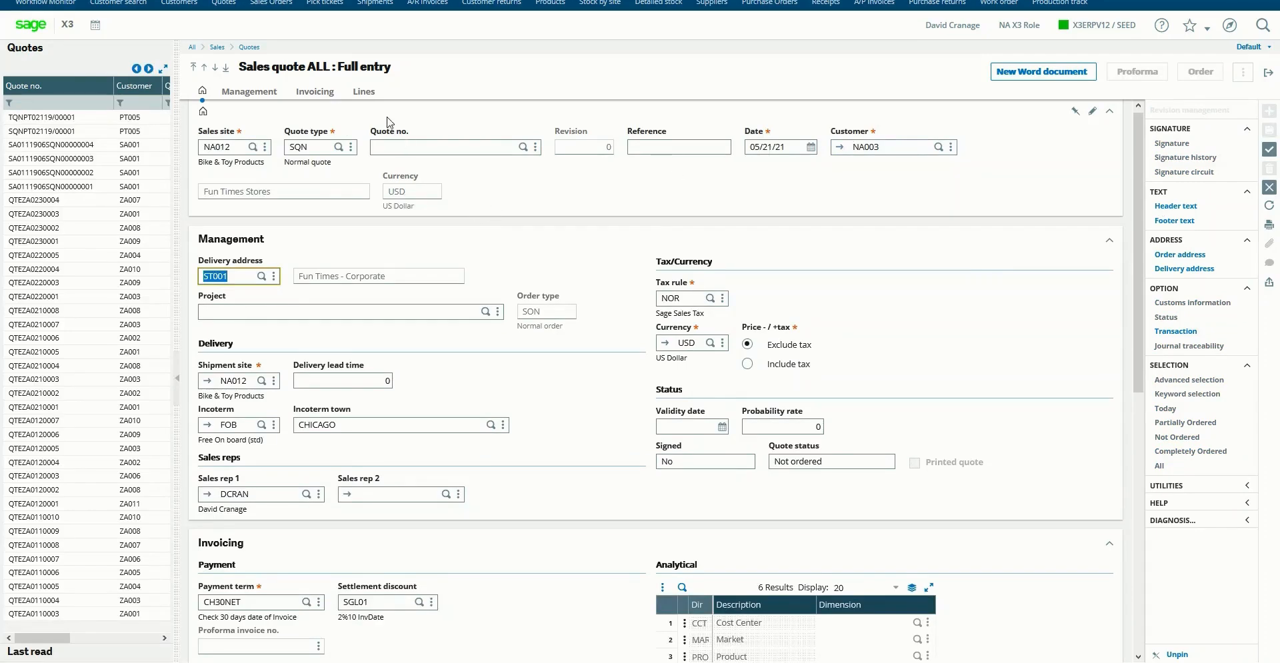
Price lists6
Manages customer-facing price lists, from looking up applicable prices and entering price list records to defining and running bulk price updates and printing price catalogs.
Price search · Price Entry · Price List Update Definition · Price List Update · Generate Price List Catalogs
CRM activity6
Covers day-to-day CRM activity tracking, including the calendar, tasks, calls, and sales opportunities.
Calendar · Tasks · Calls · Projects · Inquiries
Customer support10
Covers the customer support desk, from logging service requests and responses to tracking installed base, warranties, and service contracts.
FUNHDKAGD · Service Requests · Service Responses · Solutions · Installed Base Inquiry
Orders8
Covers sales order entry and management, open-order contracts and their delivery schedules, prepayments, and the draft-order approval workflow.
GESSOH · Open orders · Delivery Request Inquiry · Prepayment Management · Draft order validation
Common tables13
Groups shared reference tables — countries, currencies, languages, units of measure, postal codes, and tax setup — that underpin data entry across the system.
Country · Geographic subdivisions · Currencies · Currency Rates · Languages
Marketing8
Covers marketing planning, including the marketing schedule, campaigns, and the operations — such as mailings and trade shows — that execute them.
Marketing Schedule · Marketing Campaigns · Marketing operations · Mass Mailing · Call Campaigns
Allocations5
Reserves stocked products for customer orders, whether through manual reservations, automatic batch allocation, product-level allocation, or reversing an allocation.
Customer Reservations · Automatic Allocations · Automatic Deallocation · Allocations by product
Shipment preparation6
Prepares customer shipments by generating pick lists and picking tickets, planning preparation, and recording packaging and parcel details.
Generate preparation lists · Preparation plan · Declared packing · After packing · Picking tickets
Closing processes3
Runs the month-end and year-end close, generating accrual entries, currency variances, revenue recognition, and fiscal year-end postings.
Revenue recognition · Revenue recognition · Revenue recognition validation
Deliveries7
Manages the stock issue process for customer deliveries, from manual entry and automatic generation from orders to shipment validation and delivery documentation.
Deliveries · Order delivery generation · Shipment Validation · Bill of lading · Picking ticket deliveries
Invoices10
Covers customer invoicing across every trigger: direct-invoice orders, service contracts, service requests, invoicing schedules, shipments, and intercompany transfers, along with validation and prepayment issuance.
GESSIH · Automatic Order Invoicing · Automatic contract invoice generation · Automatic Service Invoice Generation · Scheduled invoice generation
BP tables8
Groups the reference tables that configure business partner settlement behavior, covering payment methods and terms, discounts, direct debit mandates, and print templates.
Payment methods · Early discount/Late charge · Direct debit mandate · Print templates · Unavailable Periods
Returns4
Records goods, loaned items, and subcontract materials returned by customers or suppliers, with related credit memos and non-conformance handling.
Customer Returns · GESSRL · GESSRS
Inquiries34
Provides reporting and lookup views across the sales cycle, covering quotes, orders, deliveries, invoices, returns, allocations, and picking and parcel detail.
Quotes · List of Quotes · Quote lines · Quote by period · Quote by sales representative
Utilities4
Provides maintenance tools for sales data, including resynchronizing customer credit balances, calculating sales commissions, and initializing tax codes for Sage Sales Tax.
Resynch. Cust. balances Resynchronization of customer balances · Paid commissions · SST initialize open documents
BPs19
Covers business partner master data, including customers, suppliers, prospects, leads, sales reps, carriers, and factoring companies, plus related categories and utilities.
BPs · Prospects · Customer category · Customers · Supplier Categories
Configurator6
Covers the product configurator, which runs configuration scenarios, manages selections, automates scenario testing, and tracks configuration history.
Configurator · Selections · Automate Configurator · Purge Configurations · Configuration history
Customer relation18
Groups the reference data behind customer relationship management, covering CRM activity setup, regeneration utilities, customer support, and marketing configuration.
CRM activity · Contact · Resource · Resource Reservations · Market sectors
Other capabilities8
Quotes
HR & Payroll
moderateHuman resources management including employee records, payroll processing, benefits administration, time and attendance, and talent management.
›11 documented capabilities in 2 areas
HR & Payroll
moderateTime management8
Covers project labor time management, from daily and weekly time entry through approval, posting, and inquiry.
Inquiries · Time verification · Time inquiry · Weekly timesheet · Time approval
Interfaces3
Exchanges data with other Sage products and third-party tools, covering treasury, cash management, consolidation, tax, and payroll integrations.
Sage payroll integration · Sage 50 import transcribe · Sage 50 payroll transactions
Warehouse Management
moderateWarehouse operations including receiving, putaway, picking, packing, shipping, and warehouse layout optimisation.
›99 documented capabilities in 15 areas
Warehouse Management
moderatePacking4
Manages packaging for outbound stock, from declaring package types to assigning parcel numbers and looking up parcel contents.
Declared packing · After packing · Parcel content inquiry
Physical management4
Covers the physical elements attached to fixed assets, including location transfers and mass issue processing.
Physical elements · Mass geographic transfer · Mass issue
Receipt/issue transactions13
Covers every stock receipt and issue transaction: multi-product receipts and issues, customer deliveries, intersite and subcontract transfers, and purchase order receiving.
GESSMR · Miscellaneous Issues · Deliveries · Deliveries · Order delivery generation
Shipment preparation6
Prepares customer shipments by generating pick lists and picking tickets, planning preparation, and recording packaging and parcel details.
Generate preparation lists · Preparation plan · Declared packing · After packing · Picking tickets
Internal flows7
Manages internal stock movement: replenishing pick locations, reordering and putting away stock, changing stock status or location, and assembling or disassembling products.
Pick location replenishment · Reorder plan · Put-away plan · Stock change · GESBBY
Deliveries7
Manages the stock issue process for customer deliveries, from manual entry and automatic generation from orders to shipment validation and delivery documentation.
Deliveries · Order delivery generation · Shipment Validation · Bill of lading · Picking ticket deliveries
License plate numbers6
Manages license plate numbers used to track containers of stock, covering their creation, assignment, and the operations and stock change transactions performed against them.
License plate number · License plate number operations · Container creation · Stock change transactions · License plate number assignment
Logistics tables15
Groups the reference tables that support logistics operations, including reasons, incoterms, shipping modes, landed costs, transport lead times, and containers.
Reasons · Return Reasons · Credit Memo Reasons · Order cancellation reason · Incoterms
Counts6
Manages physical inventory counting, from estimating annual count volumes and identifying what to count to running count sessions and tracking counts in progress.
Physical Count Calculation · Stock To Count · Stock count session · Counts · Stock Being Counted
Shipment preparation5
Prepares warehouse shipments by generating preparation lists and picking tickets, planning the pick, and looking up picking ticket status.
Generate preparation lists · Preparation plan · Picking ticket inquiry · Picking tickets
Inquiries5
Provides reporting and lookup views across the sales cycle, covering quotes, orders, deliveries, invoices, returns, allocations, and picking and parcel detail.
Deliveries · List of Deliveries · Delivery lines · Shipments by period · View routes
Utilities4
Provides maintenance tools for sales data, including resynchronizing customer credit balances, calculating sales commissions, and initializing tax codes for Sage Sales Tax.
Resynch. Cust. balances Resynchronization of customer balances · Paid commissions · SST initialize open documents
Inquiries4
Provides lookup and reporting views across stock levels, movements, allocations, locations, quality history, and MRP or MPS reorder results.
Locations · Locations · Dedicated Locations · Location Statistics
Utilities9
Provides maintenance tools for stock data, including valuation adjustments, put-away and reorder recovery, location and serial number resynchronization, and transaction consistency checks.
Recovery of put-away plan · Recovery qtys in entry · Resynchronization + stock control · Location Resynchronizations · Serial number management change
Other capabilities4
Container label printing
Business Intelligence
moderateReporting, dashboards, analytics, and data visualisation capabilities built into the ERP platform for operational and strategic decision-making.
›173 documented capabilities in 14 areas
Business Intelligence
moderate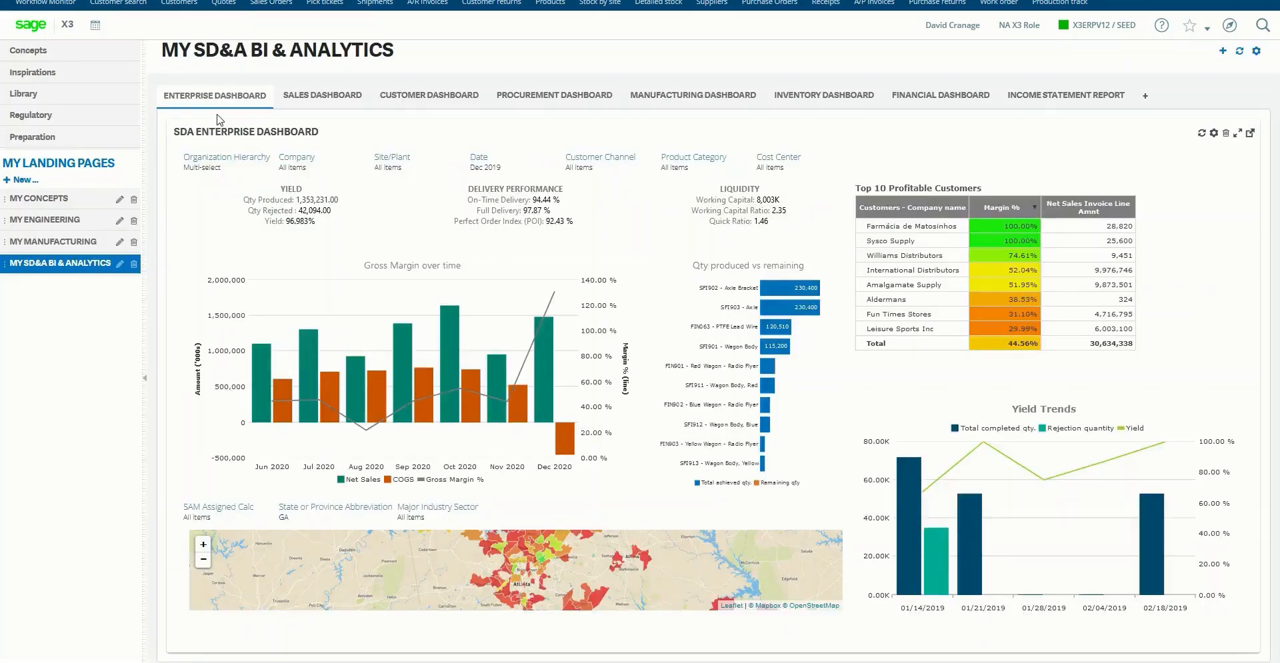
Inquiries10
Provides read-only views into general ledger balances, accounts, dimensions, entries, and bad debts.
Converted balance · Analytical balances · Balance in currency · Accounts · Natures
Performance analysis5
Compares projected and historical costs across products and sites to track cost performance over time.
Cost Comparisons · Multiple Cost Comparison · Cost History · Production Cost History
Inquiries21
Provides read-only views into production data, including work center loads, allocations, WIP, stock, planning results, and tracked activity, for monitoring shop floor status.
Loads · Loads · Graphical loads · Allocations · Allocations
Analyses4
Evaluates production output and efficiency at one or more sites, feeding resource- and product-level reports.
Production analysis · Resource analysis report · Product axis report
Reporting7
Extracts financial data for reporting, consolidation, and cash flow analysis.
Financial data extraction · Inquiry · Calculation · Extract for conso · Offset extraction
Inquiries10
Provides read-only views into customer and supplier balances, aged balances, payments, invoices, bank activity, banking position, and interest notes for tracking and risk assessment.
Customer situation · Supplier situation · Customer aged bal to date · Supplier aged bal to date · Payments
Inquiries3
Provides inquiry views for depreciation simulation results and journal traceability of fixed asset documents.
Depreciation simulation · Journal traceability
Interfaces8
Exchanges data with other Sage products and third-party tools, covering treasury, cash management, consolidation, tax, and payroll integrations.
Export open items to Sage treasury · Export payments to Sage Cash Management · Import transfers from Sage Cash Management · Consolidation export to Sage · Balance Export
Printing3
Covers print formats for tax management and fees declaration reports.
Tax management · Fees declaration
Inquiries31
Provides reporting and lookup views across the sales cycle, covering quotes, orders, deliveries, invoices, returns, allocations, and picking and parcel detail.
Quotes · List of Quotes · Quote lines · Quote by period · Quote by sales representative
Utilities3
Provides administrative tools for resynchronizing balances, closing periods and fiscal years, and adding new ledgers.
Resynchronizations · Miscellaneous
Inquiries24
Provides reporting and lookup views across the purchasing cycle, covering requests, subcontract activity, receipts, invoices, orders, returns, and shipments.
Purchase requests · Purchase request lines · Receipts · List of receipts · Receipt lines
Inquiries40
Provides lookup and reporting views across stock levels, movements, allocations, locations, quality history, and MRP or MPS reorder results.
Stock · Stock by Site Report · Stock by product · Stock by lot · Serial Numbers
Other capabilities4
Inquiries · Service Contracts · Financial overview · Project overview
Asset Management
moderateEnterprise asset management including preventive maintenance, asset lifecycle tracking, work order management, and asset depreciation.
›54 documented capabilities in 7 areas
Asset Management
moderateFixed assets6
Covers the core fixed asset records, including expenses, assets, depreciation plans, renewal provisions, and production plans used to build and depreciate company assets.
Expenses · Asset · Depreciation plan · Provisions for renewal · Production Plan
Processes12
Groups the operational processing applied to fixed assets after creation, covering context status checks, depreciation runs, physical and accounting movements, and VAT adjustments.
Status of contexts · Movements · Capitalization of expenses · Accounting allocation modification · Depreciation method change
Physical management4
Covers the physical elements attached to fixed assets, including location transfers and mass issue processing.
Physical elements · Mass geographic transfer · Mass issue
Funding3
Covers how fixed assets are financed, including lease contracts and subsidies.
Lease contracts · Lease contract · Generation of fee events
Concession10
Covers concession contracts and the assets held under them, including renewal processing.
Contract · Concession contracts · Revisions · Concession end · Assets in concession
Utilities10
Provides maintenance utilities for fixed assets, covering recalculation, synchronization, mass recoding, data recovery, and depreciation plan cleanup.
Pending modifications · Context synchronization · Mass recoding · Abel Enterprise recovery · Current DEPREC creation
Fixed assets tables9
Groups the reference tables for fixed asset setup, covering account groups, section associations, revaluation indices, buildings, and locations.
Account groups · Associations - values · Definition of accounting funds · Revaluation coeff. and indices · Buildings
Project Management
basicProject planning, resource allocation, time tracking, expense management, and project accounting for project-centric businesses.
›31 documented capabilities in 5 areas
Project Management
basicSnapshots4
Covers point-in-time snapshots of a project's financial and operational status, plus tools to compare snapshots over time.
Financial snapshots · Project snapshots · Financial snapshot comparison
Utilities5
Covers extraction and synchronization utilities for project financial snapshots, status data, and linked sales orders.
Financial snapshot extraction · Project snapshot extraction · Financial status extraction · Sales order resynchronization
Time management8
Covers project labor time management, from daily and weekly time entry through approval, posting, and inquiry.
Inquiries · Time verification · Time inquiry · Weekly timesheet · Time approval
Projects8
Groups project reference data, including task categories, cost types, financial overview report structures and queries, and time categories.
Task category · Cost type · Financial overview structure · Financial overview structure · Financial overview queries
Other capabilities6
Financial overview · Project overview
Ecommerce
basicIntegrated ecommerce and online storefront capabilities including B2B and B2C portals, product catalogue management, and order management.
Sage X3 does not offer or rate: Field Service.
Ready to move on Sage X3?
Price it, put it head-to-head with alternatives, or talk to a partner who has implemented it.
Sage X3 add-ons & integrations
Extend Sage X3 with best-of-breed software that integrates with it:
Highlighted product links go straight to the vendor and are affiliate links — we may earn a commission if you sign up. This never affects which products we list or how we rank them.
Sage X3 Modules FAQ
What is Sage X3?
Sage X3 is a mid-market ERP from Sage Group built for process and mixed-mode manufacturers and distributors, with particular strength in batch/formula production, multi-site operations, and finance. It covers financial management, manufacturing, supply chain, inventory, and procurement, and is deployed by roughly 5,000+ mid-market companies across 70 countries, especially in food & beverage, pharmaceuticals, and wholesale distribution.
How much does Sage X3 cost?
Sage X3 pricing starts around $100 per user per month, placing it in the mid-range tier alongside comparable mid-market manufacturing ERPs. Total implementation cost typically runs $100K–$400K depending on company size and scope, with projects taking roughly 4–9 months. Because deployment (cloud or on-premise) and module mix affect the final price, get a quote scoped to your requirements.
What is Sage X3 used for?
Sage X3 is used by midsize manufacturers and distributors to run financial management, production planning, inventory, and procurement in one system, with particular strength in process manufacturing — batch and formula production, multi-site operations, and multi-legislation compliance. It's a common fit for food & beverage, pharmaceutical, and distribution companies needing strong manufacturing and finance without enterprise-scale complexity.
Is Sage X3 cloud-based?
Sage X3 offers both cloud and on-premise deployment options, giving buyers flexibility depending on infrastructure preference and industry compliance needs. This flexible deployment model is one of Sage X3's advantages over cloud-only competitors, particularly for manufacturers with existing on-premise infrastructure or data residency requirements.
What size business is Sage X3 for?
Sage X3 is built for midsize companies, typically in the 251–5,000 employee range, especially process manufacturers and distributors that have outgrown entry-level accounting software but don't need enterprise-scale platforms like SAP or Oracle. Its sweet spot is mid-market businesses needing strong manufacturing and finance depth without the cost and complexity of tier-1 ERP.
What are the cons of using Sage X3?
Sage X3's main limitations are a basic built-in CRM (most customers integrate Salesforce or HubSpot instead), no field service module, a smaller partner ecosystem than SAP, Oracle, or Microsoft, and a user interface that's modernizing but still behind newer cloud-native ERPs. Its core financial and manufacturing capability is strong, so the trade-offs sit mainly outside those core areas.
Does Sage X3 offer SaaS?
Yes, Sage X3 is available as a cloud-hosted, subscription-priced deployment in addition to on-premise licensing, so it can be consumed in a SaaS-like model. Exact hosting and subscription terms depend on whether you buy through Sage directly or a Sage X3 partner, so confirm the specific delivery model during your evaluation.
When should you consider Sage X3?
Consider Sage X3 if you're a midsize process or mixed-mode manufacturer or distributor needing strong batch/formula production control, multi-site and multi-country support, and solid financial management, but don't need SAP- or Oracle-scale enterprise functionality. It's a weaker fit if CRM, field service, or ecommerce are core to your operations, since those areas are comparatively thin.
Who uses Sage X3?
Sage X3 is used by roughly 5,000+ mid-market process manufacturers and distributors across 70 countries, concentrated in food & beverage, pharmaceuticals, manufacturing, and wholesale distribution. It's typically chosen by companies in the 251–5,000 employee range that need multi-site and multi-legislation support alongside strong production and finance capability.